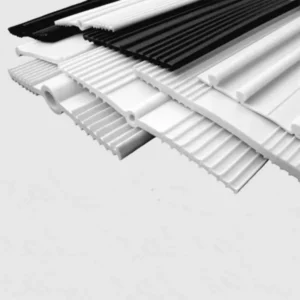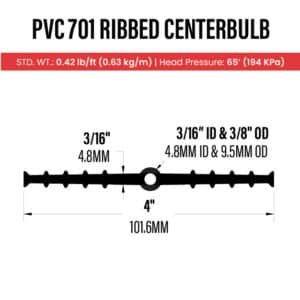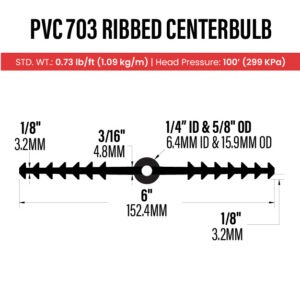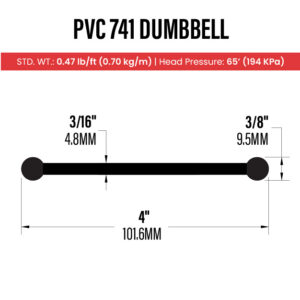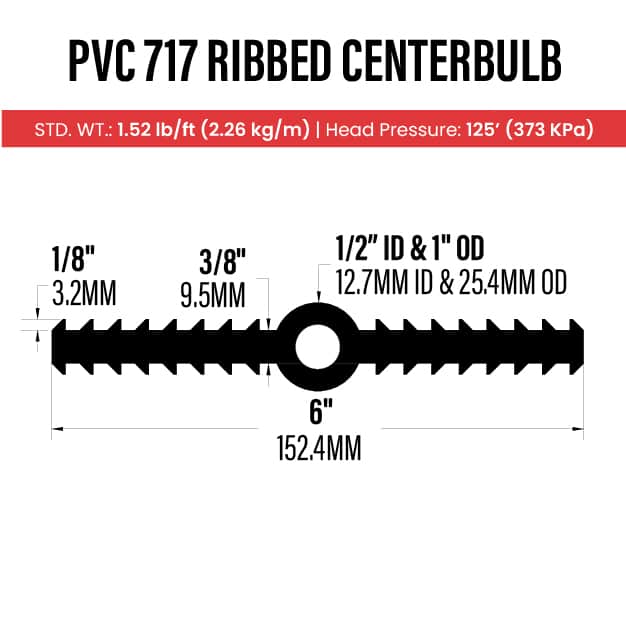
When an engineer specifies a ribbed centerbulb waterstop on a project with real head pressure — a below-grade foundation, a clarifier wall, a reservoir, a tunnel liner — the 717 is the profile that matches the spec language. Its 3/8 in. body gives it noticeably more material in the ribs and bulb than lighter 6-inch profiles, which translates to higher resistance to tearing out of green concrete and better long-term performance where the joint will keep moving for the life of the structure.
The geometry does two separate jobs. The multi-rib flanges on each side of the joint create a long, tortuous path that water under pressure cannot travel, and they anchor the waterstop mechanically into each pour. The hollow centerbulb sits at the joint line itself, flexing to accommodate expansion, contraction, and differential settlement without stressing the seal. That combination is why ribbed centerbulb profiles like the 717 are the default choice for expansion joints, and a conservative choice for construction joints that may see movement from thermal cycling or loading.
The 717 is extruded from prime virgin PVC compound — never reground or recycled material — which is what allows it to carry NSF/ANSI 61 certification for drinking water contact and to hit the tensile, elongation, and tear benchmarks in CRD-C 572-74. Typical placements include water and wastewater treatment plants, reservoirs and aqueducts, lock and dam systems, flood walls, retaining walls, foundations, tunnels and culverts, bridge abutments, and secondary containment structures.
Why Specify the 717 Ribbed Centerbulb Profile
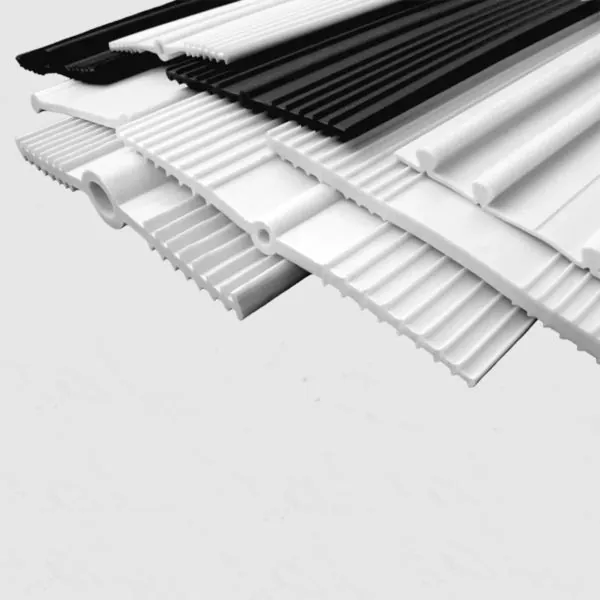
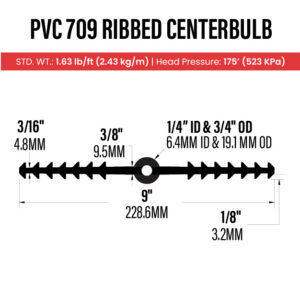
Within Sika’s Greenstreak line, 6-inch ribbed centerbulb waterstops come in more than one thickness, and the right call depends on the demands of the joint. Thinner profiles handle routine construction joints economically; the 717’s heavier 3/8 in. section is the one to reach for when the structure will hold or exclude water under significant head, when the joint is an expansion joint by design, or when the project specification calls out a heavy-bodied ribbed centerbulb profile. If the joint needs even more movement capacity, larger centerbulb and 9-inch profiles such as the Greenstreak 709 and 735 step up from there.
Field handling is straightforward for crews familiar with PVC waterstop. Straight runs splice with a butt weld using a PVC waterstop splicing iron — no adhesives, no solvents. For corners, tees, and crosses, Sika recommends factory-made fabrications so that field crews only ever weld simple straight splices, which is where the large majority of field weld failures are avoided. Rolls should be stored out of direct sunlight until installation.
One practical note for estimators: at 6 in. wide and 50 ft per roll, the 717 is sized for staging on commercial job sites without special equipment. Plan splice locations and order factory fittings when you take off quantities, and the install goes considerably faster.
Sika Greenstreak 717 Specifications
| Specification | Value |
|---|---|
| Material | Flexible PVC Waterstop |
| Shore A Hardness | 79 +/- 3 (ASTM D2240) |
| Tensile Strength | 2000 psi min (ASTM D638) |
| Elongation | 350% (ASTM D638) |
| Tear Strength | 300 lb/in min (ASTM D624) |
| Low Temperature Brittleness | Passes at -35°F (-37°C) (ASTM D746) |
| Potable Water Contact | Meets NSF ANSI Standard 61 |
Sika 717 Waterstop – Frequently Asked Questions
Where is the Greenstreak 717 typically specified? On structures that hold, carry, or exclude water under pressure: water and wastewater treatment plants, reservoirs, lock and dam systems, flood walls, below-grade foundations, tunnels, culverts, bridge abutments, and containment tanks. If a project spec calls for a 6-inch heavy-duty ribbed centerbulb PVC waterstop meeting CRD-C 572-74, the 717 is a direct match.
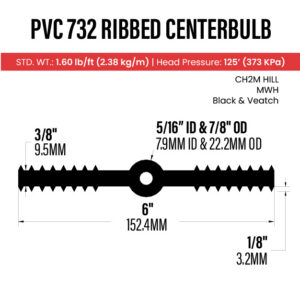
How does the 717 differ from other 6-inch Greenstreak profiles like the 703 or 732? All are ribbed centerbulb profiles; the difference is body thickness and centerbulb size, which determine how much hydrostatic pressure and joint movement the waterstop is built for. The 717’s 3/8 in. section puts it at the heavy end of the 6-inch range. Lighter 3/16 in. profiles suit routine construction joints; the 717 suits expansion joints and high-head applications.
Is the 717 suitable for expansion joints or only construction joints? Both. The centerbulb is specifically what qualifies a waterstop for expansion joints — it deforms to absorb lateral, transverse, and shear movement without breaking the seal. In a non-moving construction joint it simply adds a margin of safety.
How is the 717 installed? The waterstop is positioned at the joint centerline before concrete placement, typically using split formwork so half the profile is embedded in the first pour and half projects into the second. It must be supported and tied so it cannot fold over or displace during placement, and concrete must be consolidated fully around the ribs — voids behind the flanges are the most common cause of waterstop leaks.
How are splices, corners, and intersections handled? All splices must be heat welded with a PVC waterstop splicing iron following Sika’s splicing guidelines — adhesives and lap joints are not acceptable. Field crews should weld straight butt splices only; use factory-made fabrications for ells, tees, crosses, and changes of direction.
Is the 717 NSF certified for drinking water? Yes. The 717 meets NSF/ANSI Standard 61 for potable water contact, making it approved for municipal drinking water tanks, treatment plants, and distribution infrastructure.
Does it meet government and military project specifications? Yes. The 717 meets the physical property requirements of the U.S. Army Corps of Engineers PVC Waterstop Specification CRD-C 572-74, and PVC waterstop is the material class accepted under ACI 350 code requirements for environmental engineering concrete structures.
How should rolls be stored on site? Protect rolls from direct sunlight until installation. Beyond that, PVC waterstop has no practical shelf-life limitation, so material can be ordered ahead of the pour schedule.
Need Help Choosing the Waterstop?
We’re here to answer all of your questions about waterproofing, product compatibility, and application techniques. Get expert guidance for your specific project needs.
Professional Grade Products
Quality Customer Service
Technical Support